


Address:South of 18th Floor, New Oriental International Technology Center, 567 Jiangling Road, Binjiang District, Hangzhou City
New product development
An important synthetic pathway for the industrial production of green methanol involves a process in which hydrogen is produced via water electrolysis using electricity generated by a hybrid wind-solar power system, and then combined with CO₂ to synthesize low-energy-consumption green methanol. This process combines wind and solar energy—two renewable energy sources—and converts them into chemical energy stored in methanol through a series of steps. The hybrid wind-solar system produces no greenhouse gas emissions, significantly reducing the carbon footprint of methanol production. By directly harnessing wind and photovoltaic solar energy from nature to replace traditional fossil fuels, this approach helps alleviate the pressure of global warming. However, since wind and solar power are highly susceptible to weather conditions and cannot provide a continuous, stable energy supply 24 hours a day, and given the high costs of electricity and energy storage, the biomass gasification coupled with green electricity for methanol production can be adopted to address challenges such as the difficulties in hydrogen storage and transportation, as well as the chemical industry’s requirement for stable and continuous production.
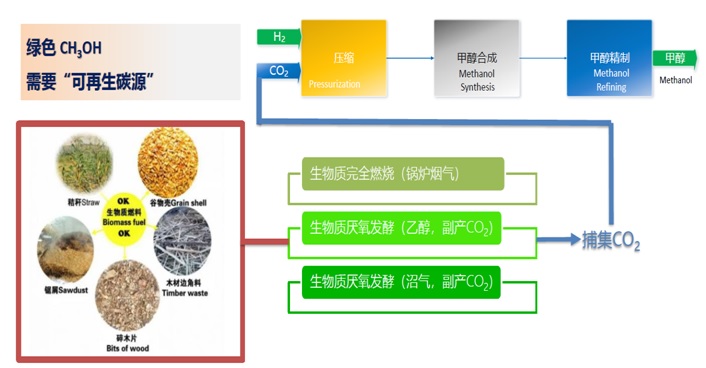
Technical Features:
1. This solution produces green methanol by coupling CO₂ generated as a byproduct of biomass combustion and fermentation with hydrogen produced via water electrolysis.
2. The project’s economic viability depends primarily on the price of hydrogen feedstock, which accounts for approximately 50–80% of total costs.
3. Our process package utilizes proprietary advanced catalysts and high-quality, efficient reactors, providing a clear competitive advantage.
4. The process route for the dual-reactor green methanol synthesis technology developed by Kuai Kai involves first passing the gas from biomass gasification through a CO + H₂ reactor. After methanol is separated, the un反応ed gas is then passed through a CO₂ + H₂ reactor to synthesize green methanol. This method eliminates the need for CO₂ recovery, greatly simplifying the production process and improving the yield of green methanol.
Hangzhou Kuai Kai possesses advanced process technologies in the field of methanol synthesis, as well as proprietary isothermal, shell-and-tube, and air-cooled coiled-tube methanol synthesis reactors. Since 1992, the R&D team has specialized in methanol synthesis process packages and reactors, having constructed over 100 methanol synthesis projects and made significant contributions to China’s co-production of methanol and ethanol, as well as low-pressure and high-pressure methanol production. With the development of new energy in China, the technology for producing hydrogen via water electrolysis and using CO₂ hydrogenation to produce green methanol has become increasingly mature. Hangzhou Kuai Kai has independently developed a catalyst and proprietary methanol synthesis tower for the one-step production of green methanol via CO₂ hydrogenation. These feature high trans-selectivity (≥15%) and high conversion rates (≥90%), along with excellent activity and long service life. Our company’s pilot-scale green methanol synthesis production facility is currently under preparation and construction, which will provide robust data support and technical assurance for the industrialization of green methanol synthesis reactors.
Green methanol produced using our company’s relevant patents, proprietary technologies, and collaborative R&D efforts holds very broad market prospects. Our company possesses proprietary process packages, reactors, and catalysts for green methanol synthesis. By advancing the recovery, application, and development of CO₂ toward a green, low-carbon, circular, and sustainable path, we are promoting the growth of the new energy industry chain.
Contact Us
Address:South of 18th Floor, New Oriental International Technology Center, 567 Jiangling Road, Binjiang District, Hangzhou City

Phone:+86-571-87177512 87177550 87177513

Email:hangzhoukuaikai@vip.163.com

Fax:0571-87177570
Quick Navigation

Browse the mobile website